Search impressions are not service calls. Learn which HVAC SEO numbers to separate, how to connect search activity to genuine enquiries, and where to make the next useful improvement.

Open fan-coil cabinet during service. DENAIR HVAC work, Dubai, UAE.
If you own an HVAC company, a report showing thousands of Google impressions may be encouraging. But it does not tell you whether your team received one more useful call.
The important question is not simply, “Are we visible?” It is: Can the right homeowner find our services, understand that we cover their area, and contact us when the job fits?
A useful SEO report separates those steps. The numbers describe different parts of the customer journey. None of them should be used as a substitute for the next one.
Start with five different measurements
1. Discoverable pages. Can search engines reach and understand the pages that explain your real services and service areas? A published page is not necessarily an indexed page, and an indexed page is not necessarily shown for a useful query.
2. Search impressions. Search Console reports how often a result associated with your website was displayed in eligible Google experiences. An impression records visibility, not an enquiry or a homeowner's intention to book.
3. Search clicks. A click shows a user followed a result to the site. It is more directly observable than an impression, but many visitors will read, compare, or leave without contacting the business.
4. Qualified enquiries. A call or form submission matters only when it is real and relevant: a service you actually provide, in an area you serve, from a person who can take the next step. Duplicate calls, spam and existing job follow-ups should be distinguished where possible.
5. Booked and completed work. A booked estimate is different from a completed, paid service call. The business can decide which marketing activity is valuable only when its own operational records are considered alongside web measurements.
A simple reporting chain is:
Search appearance → website visit → qualified enquiry → booking → completed job.
Not every journey follows this order. Someone may find you in Maps, come back directly later, or call after a recommendation. This is why a traffic chart alone cannot prove incremental revenue.
Search, Maps and AI answers serve different moments
Homeowners can encounter an HVAC company through ordinary Google results, a Google Business Profile, local maps, an AI-generated answer, or an industry information page. Those experiences overlap, but the available metrics are not identical.
Google says local results mainly depend on relevance, distance and prominence. Good information about the business and its actual service territory helps establish relevance; no content system can remove the distance factor or buy a guaranteed Maps position.
AI-enabled search adds another possible discovery surface. Accurate service information, useful answers and accessible pages remain important, but an AI mention is not itself a booked call, and an appearance is never guaranteed.
The practical approach is to track each source using the information it actually provides. Then look at the enquiries your team receives. Avoid adding together incompatible numbers and presenting them as one “lead” total.
The pages that matter answer real service questions
Imagine a homeowner with a cooling problem. Before contacting an HVAC contractor, they need answers to a few ordinary questions:
Does this company repair the type of equipment I have?
Does it serve my neighborhood or ZIP code?
Can I see evidence that it handles this kind of work?
How do I request service, and where will that request go?
A useful service page answers those questions plainly. It names real services and places, uses truthful project or technician information, and provides a working contact path. It does not need a long list of nearby cities with nearly identical text.
For an owner, this creates a concrete editorial rule: improve the pages that help a real customer make a decision before producing more pages simply to increase the count.
A Market and your own HVAC website play different roles
A separate Market + Pages can provide useful industry information, explain common questions and help visitors discover a suitable HVAC company. It is an independent digital asset that can point interested visitors toward the company's actual calls to action.
Your main HVAC website has a different responsibility: establish your service offer, qualifications, coverage, evidence and a direct route to enquiry.
These assets can also teach you different things. Search and page-performance signals can suggest which topics deserve closer attention. A topic with relevant interest may be a candidate for a stronger, original service or guidance page on the contractor's own website.
That is a decision process, not a license to copy the same article to two domains. The company's page should be written for its actual services and customers. In 1000&1's plans, this ongoing main-site work belongs to Integrated Growth or a suitably scoped Enterprise engagement—not the standalone Market plan.
One real HVAC example—and what it proves
DENAIR is an HVAC business in Dubai, UAE. Its Google Search Console data reported on the 1000&1 homepage included a comparison of two 28-day Web Search periods:
September 16–October 13, 2026: 27 clicks.
October 14–November 10, 2026: 48 clicks.
That is an observed increase in clicks between the reported periods. The original Search Console image is reproduced here with its source and dates. It is not evidence that 21 extra people booked service, that all of the change came from a single component, or that the same change will occur for a U.S. HVAC contractor.
The useful lesson is narrower: establish a baseline, compare consistent periods, preserve the original source, and distinguish a search measurement from a business result.
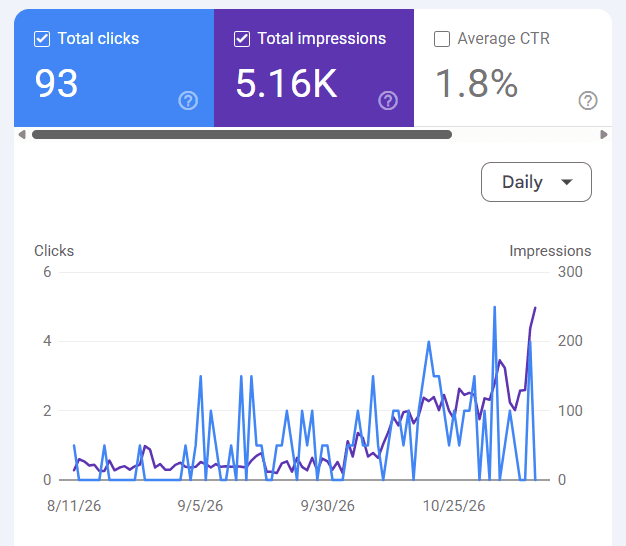
Source: DENAIR Google Search Console, Web Search. The chart covers Aug 11–Nov 10, 2026. The separate 28-day comparison is 27 clicks (Sep 16–Oct 13) versus 48 (Oct 14–Nov 10). These figures measure search clicks.
Open the full-size Search Console chart.
What to measure before the next content cycle
You do not need a complicated dashboard to begin. Keep a short, repeatable record for the services and territory you actually want to grow:
Baseline: Record available search and enquiry observations before changes. When possible, compare similar periods and account for heating/cooling seasonality.
Service fit: Identify which pages describe real work you want more of, not merely topics with high general interest.
Contact path: Test whether a visitor can find the phone number, form or booking action and whether it reaches the right team.
Enquiry quality: Record whether the person was in your service area, needed a covered service and moved toward booking. Treat duplicates separately.
Next change: Improve one meaningful page or contact step, then observe the next period. Do not declare success just because a page was published.
The goal is a loop of useful information → observable demand → better decisions → targeted improvement. Results depend on the starting point, competition, demand, execution and what your business can measure. Search rankings, traffic and jobs are not guaranteed.
A useful first step
Before paying for a redesign or another batch of pages, inspect the structure and clarity of the HVAC website you already have. Are the essential service and location pages easy to find? Do they answer the homeowner's questions? Is there a clear next action?
Check My HVAC Website to see the existing comparison route. For the full operating model, read How It Works.
Sources and context
Google Search Console: How are you performing on Google? — explains impressions, clicks and what performance reports show.
Google Business Profile: Tips to improve local ranking — relevance, distance and prominence.
Google Search Central: Creating helpful, reliable, people-first content — useful original content over mass-produced pages.
Google Search Central: AI features and your website — AI search and ordinary SEO foundations; no appearance guarantee.
1000&1 Markets: DENAIR measurement on Home — dates, attribution and original Google Search Console imagery for the Dubai example.
Scope: This article explains measurement and website development for U.S. HVAC owners. DENAIR observations are from Dubai and do not establish U.S. ranking or revenue results.

About the author
Co-Founder and CTO at 1000&1, focused on software architecture, market intelligence, data workflows and search-driven website growth.